


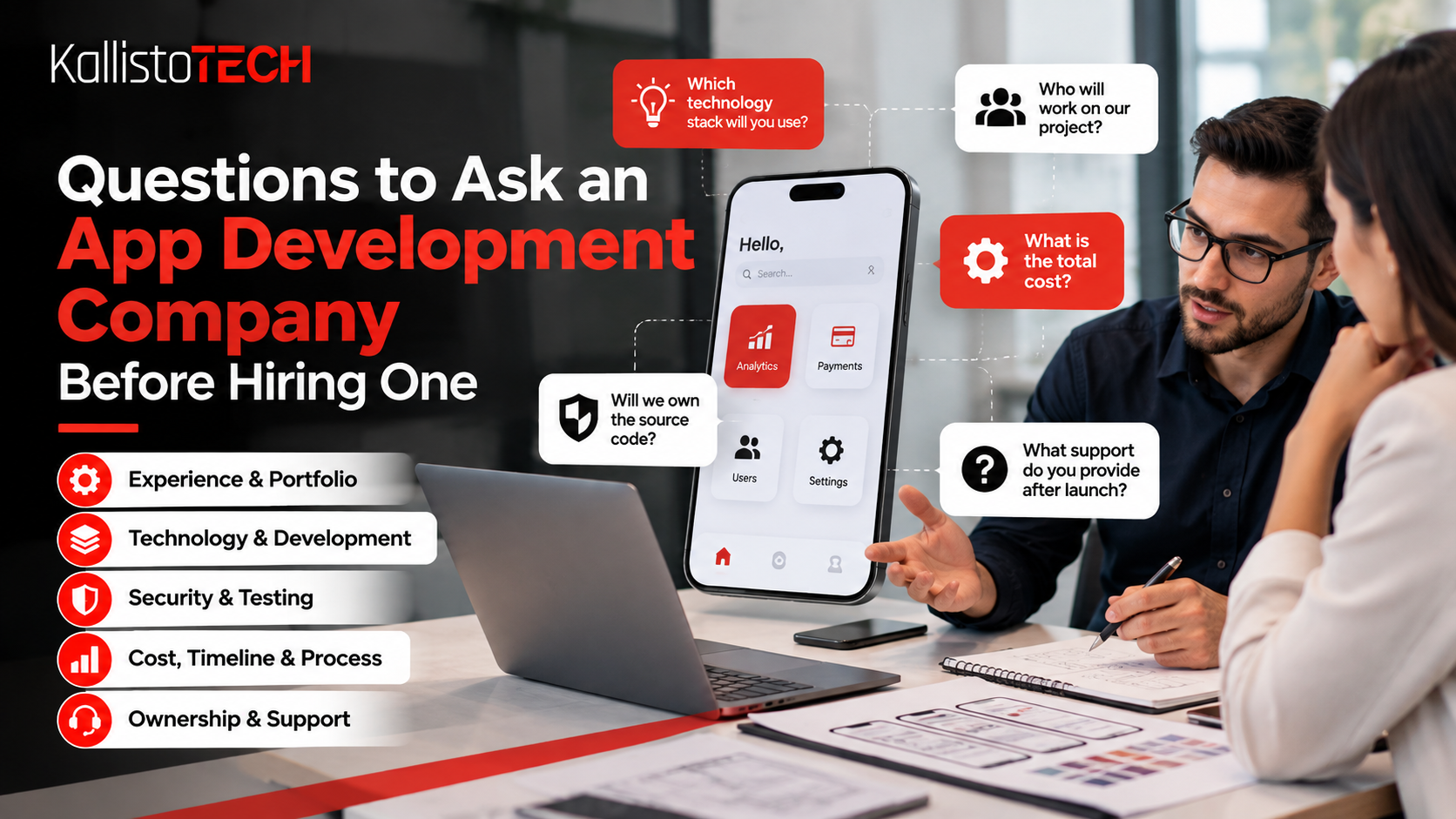
What Should You Ask an App Development Company Before Hiring Them?
Direct Answer:-
Before hiring an app development company, ask about its relevant experience, development methodology, technology stack, project team, timeline, pricing, source-code ownership, security practices, testing process, and post-launch support.
The goal is not simply to find a company that can build an app. You want to determine whether the company can build the right app, within a realistic budget and timeline, while giving your business control over the finished product.
Here are the key areas to evaluate.
1. What Experience Does Your App Development Company Have?
Start by understanding whether the company has experience developing applications similar to yours.
Ask:
- Have you developed an app similar to our idea?
- Can you show us live apps you have developed?
- Do you have experience in our industry?
- What types of applications do you specialize in?
- Can we speak with one of your previous clients?
- What was the most technically challenging application you developed?
A portfolio can demonstrate development capability, but relevant experience is particularly valuable. For example, a company developing a financial application should understand payment integrations, security, authentication, data protection, and regulatory considerations.
2. Can You Show Us Live Apps You Have Developed?
A development company should ideally be able to provide examples of completed projects.
Ask for:
- App Store links
- Google Play links
- Website or SaaS examples
- Case studies
- Before-and-after examples
- Client references
Don’t evaluate an agency only from screenshots on its website. A live application can provide a better indication of its development and user-experience capabilities.
3. How Would You Approach Our App Development Project?
Ask the development company to explain how it would approach your project from beginning to launch.
A typical process may include:
- Business and requirements analysis
- Technical planning
- User-flow development
- Wireframing
- UI/UX design
- MVP development
- Backend and API development
- Testing and quality assurance
- Beta testing
- App Store and Google Play submission
- Launch
- Post-launch maintenance
The company should be able to explain what happens at each stage and what you will receive.
4. What Should Be Included in the MVP?
If your application has many features, ask the development company to identify which features are essential for the minimum viable product (MVP).
For example, an initial marketplace application might require:
- User registration
- User profiles
- Product or service listings
- Search
- Payments
- Orders
- Notifications
- Basic administration
Advanced analytics, loyalty programs, complex automation, and additional integrations might be introduced later.
A clearly defined MVP can help control the initial development cost and allow you to validate the product before investing heavily in additional functionality.

5. Which Technology Stack Will You Use and Why?
Technology decisions can affect your application’s performance, scalability, maintenance requirements, and future development costs.
Ask:
- Will you develop natively or use Flutter or React Native?
- Which programming languages will you use?
- Which backend technology do you recommend?
- Which database will you use?
- What cloud platform will host the application?
- Why is this technology appropriate for our project?
- Can another development company maintain the application later?
There isn’t one technology stack that is automatically correct for every application. The development team should explain its recommendation based on your requirements.
6. Should We Build a Native App or Cross-Platform App?
Ask the development company whether your project should use native development or a cross-platform framework.
Native app development
Native development typically means building separately for platforms such as iOS and Android.
Potential advantages include:
- Platform-specific performance
- Greater access to native functionality
- Platform-specific user experiences
Cross-platform development
Frameworks such as Flutter and React Native can allow businesses to share a significant portion of their code across platforms.
Potential advantages include:
- Reduced duplicate development
- Faster development for some projects
- Easier maintenance of shared functionality
The appropriate approach depends on the application’s functionality, performance requirements, budget, and long-term roadmap.
7. Who Will Actually Work on Our Project?
The company you speak with during the sales process may not be the same team that develops your application.
Ask:
- Who will be our developers?
- Who is the project manager?
- Will developers be employees or subcontractors?
- Where is the development team located?
- How experienced are the developers?
- Who will be responsible for technical decisions?
- Will the same team remain assigned throughout the project?
Knowing who is responsible for the project can prevent communication problems later.
8. What Is Your App Development Process?
Ask the company to explain how it manages projects.
Important questions include:
- Do you use Agile development?
- How long is each development sprint?
- How often will we receive updates?
- Can we review working builds?
- How are requirements documented?
- How are changes approved?
- What project management software do you use?
Regular demonstrations can help identify problems before they become expensive to fix.
9. How Much Does App Development Cost?
Don’t ask only:
“How much does an app cost?”
Instead, ask for a detailed estimate.
The proposal should identify:
- UI/UX design
- Frontend development
- Backend development
- API development
- Database development
- Testing
- Project management
- Deployment
- App Store submission
- Post-launch support
Ask:
“What is included in this price, and what is not included?”
This question can uncover additional costs that aren’t obvious in an initial quote.
10. How Do You Handle Changes to the Project Scope?
App requirements often change during development.
Ask:
- How do you handle change requests?
- How are additional features priced?
- Who approves additional costs?
- Will a change affect the deadline?
- How will scope changes be documented?
A formal change-management process can reduce disagreements about cost and delivery dates.
11. Who Owns the Source Code?
This is one of the most important questions to ask an app development company.
Ask directly:
“Will we own the complete source code after the project is completed?”
Also ask whether you will receive access to:
- Source code
- GitHub or GitLab repository
- UI/UX files
- Database
- Backend
- APIs
- Cloud infrastructure
- Documentation
- App Store account
- Google Play developer account
Your contract should clearly define ownership and access rights.
12. Can We Move to Another Development Company Later?
Ask:
“If we decide to work with another development company in the future, can they take over this application?”
A professionally structured application should not unnecessarily lock your business into one vendor.
You should understand:
- Where the source code is stored
- Who controls the repository
- Who owns the cloud account
- Who owns third-party accounts
- What documentation will be provided
- How another developer can take over the project
13. How Will You Protect Our App and User Data?
Security should be discussed before development begins.
Ask about:
- Data encryption
- Authentication
- Authorization
- Secure API development
- Password protection
- Payment security
- Database security
- Access controls
- Backup procedures
- Security testing
- Vulnerability management
If the application handles financial, healthcare, personal, or other sensitive information, ask what specific compliance requirements apply to the project.
14. What Testing Will You Perform?
Ask:
“Who is responsible for QA and testing?”
Testing may include:
- Functional testing
- UI testing
- Usability testing
- API testing
- Performance testing
- Security testing
- Device testing
- Browser testing
- Regression testing
- User acceptance testing
Ask which devices and operating-system versions will be tested before launch.
15. What Happens If We Find Bugs After Launch?
Bugs can appear after an application goes live.
Ask:
- Is post-launch bug fixing included?
- How long is the warranty period?
- What qualifies as a bug?
- How quickly are critical issues addressed?
- Is emergency support available?
- What is the ongoing maintenance cost?
Get these details in writing rather than relying on verbal promises.
16. Will You Handle App Store and Google Play Submission?
Launching an application involves more than finishing the code.
Ask whether the development company will help with:
- Apple App Store submission
- Google Play submission
- App descriptions
- Screenshots
- App icons
- Privacy information
- Store rejection issues
- Production deployment
- App updates
Also make sure the developer accounts are owned by your business rather than permanently controlled by the development company.
17. Will You Integrate Analytics?
Analytics can help you understand how users interact with your application.
Ask whether the company can implement tools such as:
- Firebase Analytics
- Google Analytics
- Crash reporting
- Conversion tracking
- Event tracking
- User funnels
- Revenue tracking
For example, you may want to know how many users register, complete onboarding, make purchases, submit forms, or cancel subscriptions.
18. What Post-Launch Support Do You Provide?
App development does not necessarily end when the application is published.
Ask about:
- Bug fixes
- Security updates
- OS compatibility
- Server maintenance
- Performance monitoring
- Feature updates
- Technical support
- Backup management
- Emergency support
Also ask whether support is included or charged separately.
19. What Happens When Apple or Android Releases a Major Update?
Mobile operating systems change regularly.
Ask:
“How will you maintain our app when Apple or Android releases a major operating-system update?”
Your contract should clarify who is responsible for maintaining compatibility and whether this work is included in your maintenance agreement.
20. What Questions Should You Ask Before Signing the Contract?
Before signing, confirm these points in writing:
- Complete project scope
- Feature list
- Technology stack
- Development timeline
- Project milestones
- Payment schedule
- Change-request process
- Source-code ownership
- Intellectual property ownership
- Hosting ownership
- Third-party services
- Security responsibilities
- Testing responsibilities
- Bug-fixing period
- Post-launch support
- Maintenance costs
- Termination conditions
- Project handover process
A detailed contract can prevent misunderstandings later.
10 Most Important Questions to Ask an App Development Company
If you are meeting an app development company for the first time, start with these ten questions:
- Have you developed an app similar to ours?
- Can you show us live applications you have built?
- What technology stack would you recommend and why?
- What features should be included in our MVP?
- What is the complete development cost, including additional services?
- What is the realistic development timeline?
- Who exactly will work on our project?
- Will we own 100% of the source code and intellectual property?
- What testing and security measures are included?
- What support and maintenance will you provide after launch?
What Should You Look for in an App Development Company?
Look for a development partner that provides clear communication, relevant technical experience, transparent pricing, documented processes, strong security practices, comprehensive testing, clear ownership terms, and dependable post-launch support.
Don’t choose a company solely because it offers the lowest quote. A lower initial development price can become more expensive if the project requires extensive redevelopment, has poor documentation, or creates long-term maintenance problems.
The most useful comparison is between scope, technical approach, team, ownership, timeline, support, and total cost of ownership.
Final Checklist Before Hiring an App Development Company
Before signing your development agreement, make sure you can answer “yes” to these questions:
- Do they have relevant app development experience?
- Have you reviewed their live applications?
- Is the scope clearly documented?
- Is the MVP clearly defined?
- Is the technology stack explained?
- Is the development timeline realistic?
- Is the pricing transparent?
- Are change requests clearly defined?
- Will your business own the source code?
- Will you control your developer accounts and infrastructure?
- Are security requirements documented?
- Is QA/testing included?
- Is post-launch support clearly defined?
- Is the handover process documented?
A strong app development partnership starts with clear expectations. Asking these questions before development begins can help you understand exactly what you are buying, who controls the finished product, and what will happen after the application launches.
Frequently Asked Questions
What should I ask an app development company before hiring them?
Ask about their relevant experience, portfolio, technology stack, development process, project team, pricing, timeline, source-code ownership, security, testing, and post-launch support.
How do I choose an app development company?
Compare companies based on relevant experience, technical approach, communication process, project scope, pricing transparency, ownership terms, testing practices, and ongoing support.
How much does it cost to develop a mobile app?
Mobile app development costs vary significantly depending on the application’s features, platforms, integrations, design requirements, backend complexity, security requirements, and development team. Request a detailed project estimate instead of relying on a generic price.
How long does it take to develop an app?
The timeline depends on the scope and complexity of the application. A simple MVP can require substantially less development time than a complex marketplace, fintech platform, healthcare application, or enterprise system.
Should I hire a freelance developer or an app development company?
The appropriate option depends on your project’s complexity, budget, management requirements, and need for ongoing support. A development company may provide a broader team covering design, development, QA, project management, and maintenance, while a freelancer may be appropriate for smaller or highly focused projects.
Who should own the app source code?
For a custom application commissioned by a business, the contract should clearly establish who owns the source code and intellectual property. Businesses should also clarify access to repositories, hosting, databases, APIs, and developer accounts before development begins.
What is an MVP in app development?
An MVP, or minimum viable product, is the initial version of an application containing the core functionality needed to launch, test the concept, and gather feedback. Additional features can be developed after the core product has been validated.
Should an app development company provide post-launch support?
Post-launch support is often important because applications require bug fixes, security updates, operating-system compatibility updates, server maintenance, and ongoing improvements. The scope and cost of support should be defined in the development agreement.
Conclusion
Hiring an app development company is not simply a matter of comparing quotes. The development partner you select can affect your application’s technology, security, scalability, maintenance costs, and long-term ownership.
Before signing an agreement, ask detailed questions about experience, technology, MVP scope, pricing, development methodology, source-code ownership, security, testing, app-store deployment, and post-launch support.
The more clearly these issues are defined before development begins, the fewer surprises you are likely to encounter later.


