


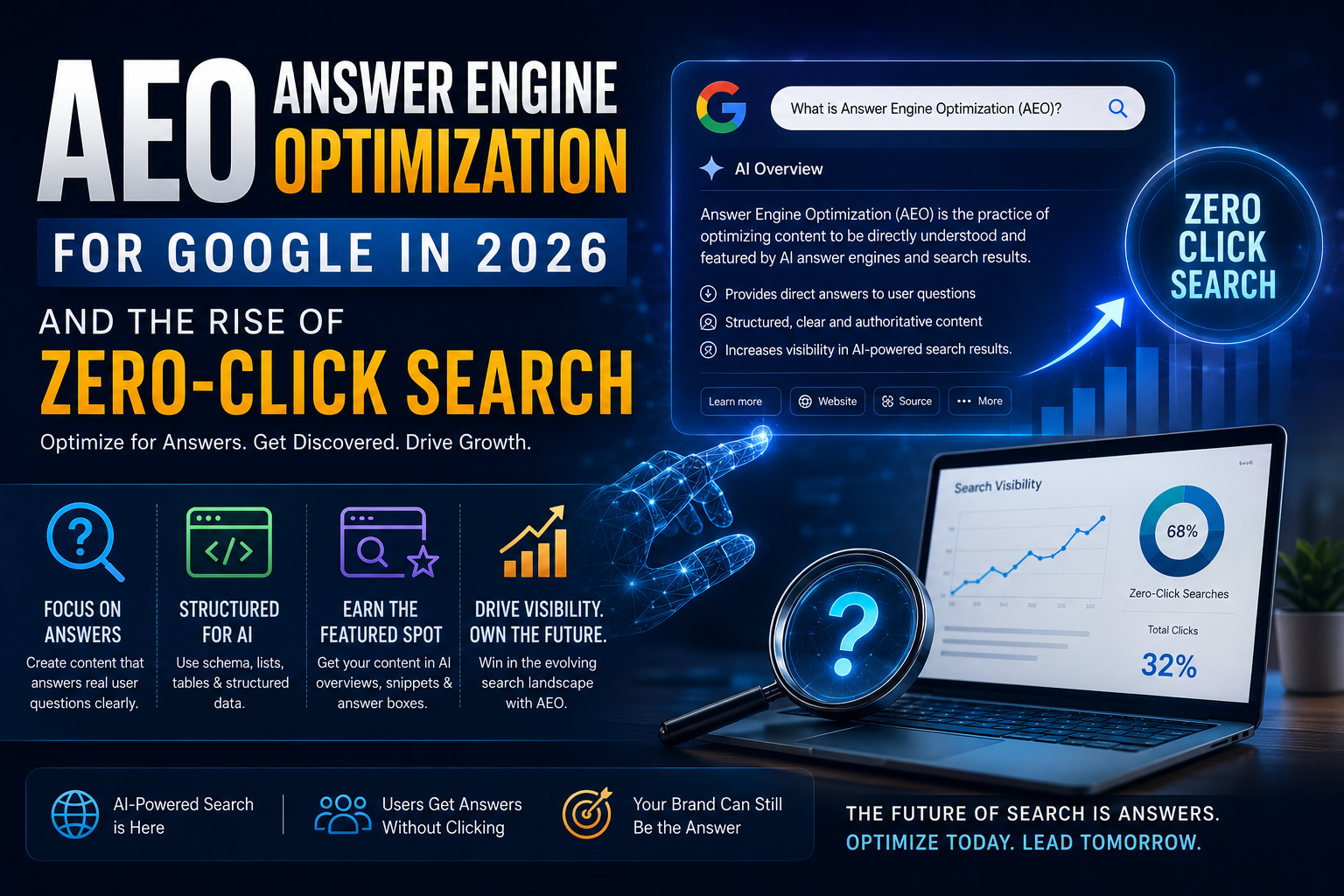
AEO: Answer Engine Optimization for Google in 2026 and the rise of zero-click search
Introduction
Zero-click content gives people complete answers directly within Google or an AI-generated response, eliminating the need to click through to a website.
Google AI Overviews and tools like ChatGPT now answer many questions instantly, changing how website traffic behaves and how buyers discover brands.
Zero-click content means an answer card or AI-generated response provides everything a searcher needs without requiring a visit to a website. Google AI Overviews, ChatGPT, and Perplexity often reduce reported traffic while real demand remains steady or continues to grow. Brand authority is increasingly reflected in how often these systems mention, cite, and describe your business as a credible source. The shift toward AEO (Answer Engine Optimization) focuses on creating content that answer engines can understand, trust, and cite.
A widely cited example comes from NerdWallet. According to the company, revenue increased by approximately 35 percent while traffic declined by 20 percent. Those figures illustrate how incomplete traditional reporting can be when it focuses only on clicks and sessions.
If your traffic dashboards feel disconnected from sales conversations and closed deals, you are not imagining it.
Keep reading to learn what matters now and how to measure it.
Key Takeaways
This overview sets expectations before we explore the details. Each point highlights how AEO and brand authority are changing the way marketing success is measured.
Traditional traffic metrics are becoming less meaningful.
As AI tools answer more questions directly, traffic reports may show growth while pipeline performance remains unchanged. Clicks and pageviews measure activity, but they do not always reflect trust, purchase intent, or business impact.
Brand authority is becoming a competitive advantage.
In 2026, brand authority means your company is consistently recognized as a credible source within your industry. AI assistants reference your brand by name, and prospects arrive already familiar with your expertise. That influence extends beyond your website into search, AI platforms, and other digital channels.
AEO builds on the foundation of SEO.
Strong rankings still matter, but answer engines increasingly prioritize content that provides clear, well-supported answers. When your content follows these patterns, AI systems are more likely to reference it.
The most valuable metrics focus on visibility and business outcomes.
Organizations should track how often Google AI Overviews, ChatGPT, and Perplexity mention their brand, how those mentions are framed, and whether they contribute to qualified leads and revenue growth.
Why Traffic Metrics Are No Longer Telling the Full Story
Traffic metrics no longer provide a complete picture because buyer decisions increasingly happen inside AI-generated answers and zero-click search results. Dashboards built around sessions and clicks capture only part of your brand’s influence.
One challenge is relying too heavily on vanity metrics. Numbers such as:
- Pageviews
- Impressions
- Keyword rankings
- Bounce rate
can look impressive in reports but do not necessarily demonstrate buyer trust or purchase intent.
According to Gartner, traditional search volume could decline by approximately 25 percent by 2026 as AI answer engines become more widely adopted. Many organizations are already seeing a pattern where traffic increases while sales remain unchanged.
Zero-click behavior widens this gap. Google AI Overviews, ChatGPT, Perplexity, Microsoft Copilot, and voice assistants such as Siri and Alexa provide answers directly on screen. Users compare options, form opinions, and create shortlists without visiting a website.
According to OpenAI, more than 400 million people use its products each week. As AI adoption continues to expand, this behavior is expected to become even more common.
As a result, web analytics represent only part of the customer journey. Your content may influence thousands of potential buyers through AI-generated answers without producing a noticeable increase in website sessions.
This is why KallistoTECH encourages clients to focus less on raw traffic and short-term spikes and more on qualified leads, pipeline value, and brand visibility within answer engines.
What Is AEO and Why Is It the New Standard for Brand Visibility?
AEO (Answer Engine Optimization) is the practice of creating and structuring content so AI systems can easily understand, trust, and cite it.
Instead of competing solely for traditional search listings on Google, AEO helps position your brand as the source cited within Google AI Overviews, ChatGPT, Perplexity, and similar platforms.
Traditional SEO focuses on ranking pages and generating website visits. AEO focuses on having your content cited as the answer, even when the user never clicks through to your website.
Effective AEO often includes:
- Direct answers near the top of a page
- Headings that reflect real customer questions
- Visible trust signals such as expert bylines and credible citations
Research indicates that approximately 99 percent of URLs cited within Google’s AI experiences already rank within the top 20 organic results. Strong SEO increases the likelihood that your content will be considered by AI systems. AEO then helps answer engines understand and reference that content more effectively.
| Dimension | SEO Focus | AEO Focus |
| Primary Goal | Rankings and clicks | Citations in AI answers |
| Success Metrics | Rankings, CTR, organic traffic | Brand mentions and share of answers |
| Trust Signals | Backlinks and domain authority | Expertise, recency, and sourcing |
| Content Format | Comprehensive pages | Clear, self-contained answer sections |
AEO is becoming increasingly important as tools such as Google Gemini, Copilot, and voice assistants handle more of the research process for potential buyers.
If your content is not structured in a way that answer engines can easily interpret, it becomes less likely to be cited.
To improve AEO performance, many organizations:
- Answer primary questions within the opening paragraphs
- Use H2 and H3 headings based on customer questions
- Implement structured data where appropriate
- Cite authoritative sources and identify subject matter experts
Small adjustments like these can significantly improve how AI systems interpret and reference your content.
How to Measure Brand Authority in an AI-First World
Measuring brand authority in an AI-first environment requires looking beyond website traffic.
The focus shifts toward visibility within AI-generated answers and the quality of the leads that visibility generates.
Key AEO metrics include:
AI Visibility Score
Measures how often your brand appears in responses from Google AI Overviews, ChatGPT, Perplexity, and similar platforms.
Citation Score
Measures how frequently AI systems attribute information to your website or reference your research.
Sentiment Score
Measures whether AI systems describe your brand positively, neutrally, or negatively.
Accuracy Score
Measures whether information about your products, services, pricing, and expertise is presented correctly.
You can also monitor Share of Voice across important customer questions. KallistoTECH reporting frameworks and platforms such as Profound and HubSpot can help identify which brands are most frequently referenced.
Manual reviews can also provide useful insights. Enter important customer questions into ChatGPT, Perplexity, and Google AI Overviews to see whether your brand appears and how it is described.
| KPI | What It Measures |
| AI Visibility Score | Frequency of brand mentions in AI responses |
| Citation Score | Number of citations and attributions |
| Sentiment Score | Tone used when describing your brand |
| Accuracy Score | Correctness of information presented |
| Share of Voice | Visibility compared with competitors |
| Assisted Conversions | Leads and sales influenced by AI exposure |
These metrics provide a stronger connection to business outcomes than traffic alone.
HubSpot has reported significant increases in qualified leads through its AEO initiatives, demonstrating how visibility within answer engines can translate into meaningful business results.
As Peter Drucker famously said:
“What gets measured gets managed.”
A clear AEO measurement framework helps organizations manage the authority and visibility assigned to them by AI systems.
How KallistoTECH Helps Businesses Build Brand Authority
KallistoTECH combines SEO and AEO into a unified strategy designed to improve both search visibility and AI discoverability.
The objective is not only to improve rankings but also to position your company as a credible source that answer engines regularly cite when potential customers research solutions.
The SEO and AEO service focuses on:
- Content designed to answer customer questions
- Technical website optimization
- Structured data implementation
- Expert bylines and trust signals
- Ongoing content updates
- Credible external citations
With more than 18 years of experience and work completed for over 250 businesses, KallistoTECH focuses on connecting marketing performance to revenue outcomes rather than traffic metrics alone.
Key services include:
Lead Generation
Programs designed to attract qualified prospects rather than simply increasing website visits.
Marketing in a Box
Integrated marketing across search, social media, and email channels to maintain consistent positioning.
Conversion-Focused Web Design and Mobile Apps
Digital experiences designed to build trust and improve conversion rates for visitors arriving from search engines and AI platforms.
How to Grow My Business Blueprint
A strategic framework that aligns SEO, AEO, and marketing activities with measurable business objectives.
“Most agencies talk about metrics, while only a few truly connect marketing activity to revenue.”
AJ Aluthwala, CEO, KallistoTECH
Why Brand Authority Matters More Than Traffic
Traffic provides a snapshot of performance, while brand authority builds value over time across search engines, AI platforms, and digital channels.
As zero-click content and AI-generated answers become more common, many buyers form opinions and shortlist vendors before ever visiting a website.
Organizations that continue to evaluate success primarily through pageviews risk overlooking stronger indicators of business performance.
Brand authority is reflected in:
- How often AI platforms cite your content
- How accurately those platforms describe your business
- How familiar prospects are with your company before engaging with sales
A practical first step is to:
- Identify your most important customer questions.
- Search those questions in Google, ChatGPT, and Perplexity.
- Review whether your brand appears, how it is described, and which competitors are referenced.
This process helps identify opportunities to improve content, strengthen trust signals, and increase visibility within answer engines.
If you are looking for a partner that approaches SEO and AEO as a unified strategy, KallistoTECH provides audits, strategy development, and implementation support. A strategy call at kallistotech.com can be a useful first step toward reporting that aligns more closely with business outcomes and revenue growth.
Frequently Asked Questions
What is the difference between AEO and SEO?
AEO focuses on helping your brand appear within AI-generated answers, while SEO focuses on improving search rankings and generating website traffic.
The two disciplines work together. Strong SEO improves your visibility, while AEO helps answer engines understand and cite your content.
A useful guideline is to write for people first and then structure the content so search engines and AI systems can easily understand it.
Why are my website traffic numbers increasing while leads remain flat?
Traffic can increase while leads remain unchanged when visitors have low purchase intent or are still in the research stage.
At the same time, AI tools such as ChatGPT and Google AI Overviews may answer important questions without sending users to your website.
Comparing traffic with conversion rates, pipeline creation, and sales activity often provides a more meaningful picture of performance.
How do I know if AI engines are mentioning my brand?
You can monitor AI mentions using platforms such as Profound, HubSpot’s AEO reporting tools, or KallistoTECH’s reporting frameworks.
You can also conduct manual reviews by entering common customer questions into ChatGPT, Perplexity, and Google AI Overviews to see whether your brand appears and whether the information presented is accurate.
How quickly can a business see results from AEO?
Many organizations begin seeing early results within approximately 90 days, particularly when optimizing pages that already perform well in search.
A typical process includes auditing content, restructuring key pages, implementing technical improvements, and monitoring visibility across answer engines.
Early improvements often come from adding concise answers, structured data, and stronger trust signals to existing content.
Is AEO only relevant for large companies?
No. AEO can be effective for small businesses, startups, and large enterprises alike.
The most important requirements are clear answers, well-structured content, and visible trust signals.
By focusing on a small number of high-intent questions and priority pages, smaller organizations can compete effectively within Google AI Overviews, ChatGPT, and other answer engines without maintaining a large content team.


