


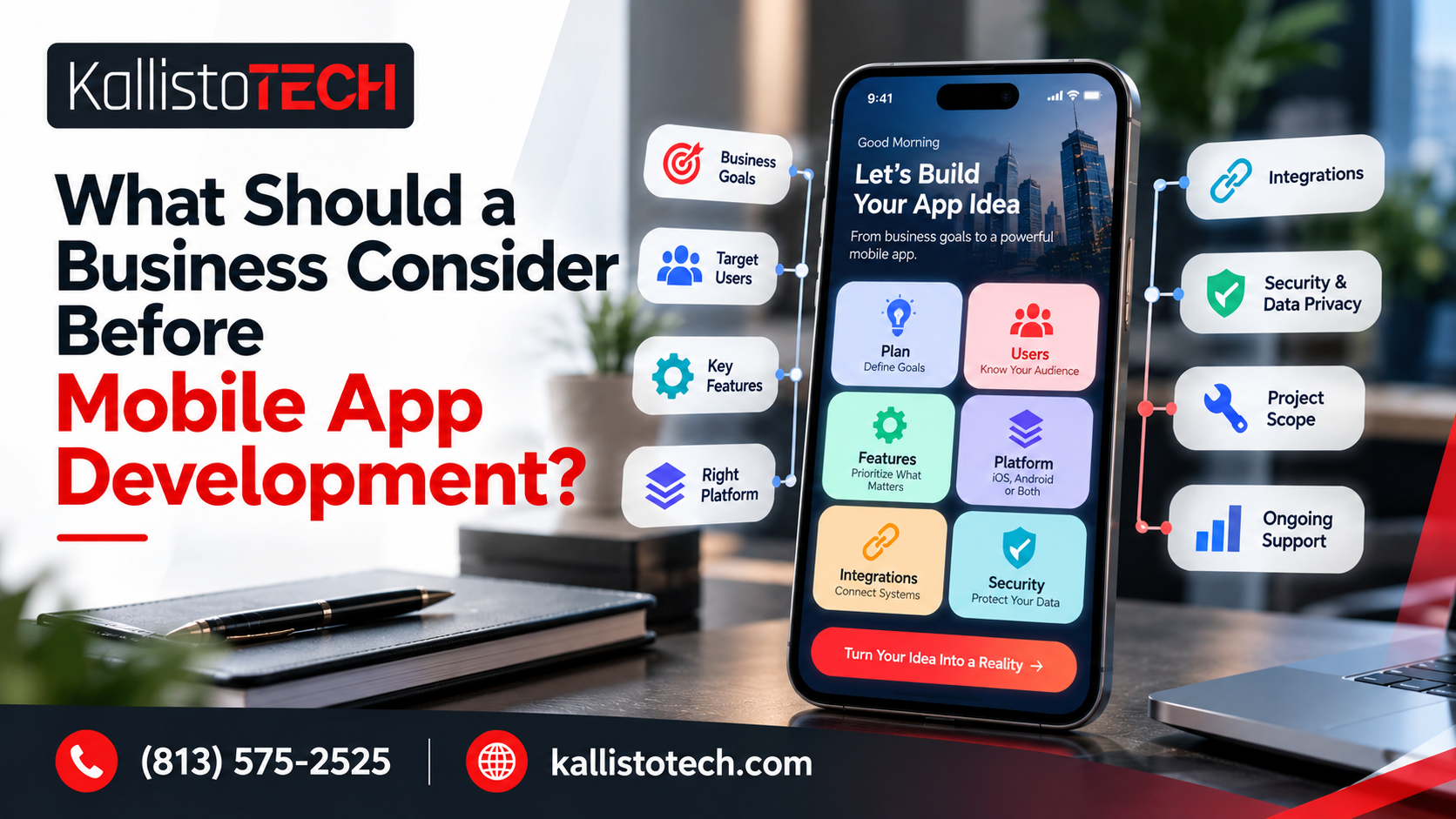
What Should a Business Consider Before Mobile App Development?
Before starting mobile app development, a business should define what the app needs to accomplish, who will use it, which features are essential, and how it will be supported after launch.
A clear plan can help reduce unnecessary features, scope changes, unexpected costs, and development delays. It can also help determine whether a mobile app is the right solution for the business.
Define Your Business Goal First
Start with the business problem rather than a list of features.
A business may want an app to:
- Simplify booking, ordering, or purchasing
- Improve customer communication
- Automate repetitive tasks
- Support employees or internal workflows
- Improve customer retention
- Deliver a digital service
- Replace inefficient manual processes
The goal should be measurable. Depending on the project, success could mean more completed bookings, fewer manual tasks, faster workflows, or more completed purchases.
Defining the goal can also help determine whether a mobile app is the right solution. In some cases, a website, web application, or software integration may solve the problem more efficiently.
Know Who Will Use the App
A mobile app should be planned around the people who will use it.
Before development, define:
| Area | What to Define |
| Target users | Customers, employees, partners, or other users |
| User needs | What users need to accomplish |
| Pain points | Problems the app should solve |
| Devices | iOS, Android, tablets, or multiple devices |
| Usage patterns | When, where, and how users access the app |
| Core action | The most important task users need to complete |
For example, a customer-facing shopping app may need product search, payments, order tracking, and account management. An internal employee app may focus on workflow automation, approvals, reporting, or access to company systems.
Understanding users and their primary tasks helps determine which features are actually necessary.
Prioritize the Features That Matter Most
Trying to include every possible feature can increase development time, complexity, and cost.
For custom app development, businesses should focus first on features that directly support the main business goal and user needs.
Instead, divide features into clear priorities:
- Must have: Essential for the first release
- Should have: Useful but not essential
- Later: Features that can be evaluated after launch
A useful question is:
What is the one core task the first version must help users complete?
Keeping that task at the center of the project can help control scope and create a clearer development road map.
Additional features can be evaluated after the business has validated the core experience and identified further user needs. This approach can help keep the initial project focused without unnecessarily increasing its complexity.
Choose the Right Mobile App Platform
The platform should match the target audience and technical requirements. Depending on the project, a business may consider:
- Native iOS development for Apple devices
- Native Android development for Android devices
- Cross-platform development when one code base can support multiple platforms
In some cases, a web application or progressive web application may be more appropriate than a dedicated mobile app.
There is no single platform that works for every business. The technology should be selected according to the project’s actual requirements.
Plan Your Integration and Data Requirements
Many business apps need to connect with existing software and services.
Common requirements include:
- CRM platforms
- Payment gateways
- Accounting software
- E-commerce systems
- Booking platforms
- Inventory systems
- Customer databases
- Business APIs
- Cloud services
An admin dashboard may also be needed to manage users, orders, bookings, content, payments, notifications, or reports.
Identifying these requirements before development can reduce the risk of major scope and architecture changes later.
Plan for Security and Data Privacy
Security should be considered early in the development process, especially when an app handles accounts, payments, personal information, or confidential business data.
Depending on the application, planning may include:
- Secure authentication and access control
- Data encryption
- Secure APIs
- Payment protection
- Data storage and retention
- Security testing
- Privacy requirements
Businesses should understand what information the app collects, where it is stored, who can access it, and how it will be protected.
Planning these requirements early can reduce the risk of significant architectural changes later.
Set a Clear Project Scope
A clear scope gives the business and development team a shared understanding of what will be delivered.
Before development begins, define:
- Core requirements
- Features for the first release
- Platform requirements
- Required integration
- Project milestones
- Testing requirements
- Included and excluded work
- Acceptance criteria
- Scope-change procedures
- Ownership of code and digital accounts
A focused first release should not be given the same timeline or budget expectations as a complex application with multiple platforms, integration, and user roles.
A documented change process can also reduce confusion and unexpected costs.
Find the Right Mobile App Development Company
If you are looking for a mobile app development company, evaluate potential partners based on your project’s requirements rather than price alone.
Consider:
- Relevant development experience
- Similar projects or case studies
- Technical and integration capabilities
- Source code and account ownership
- Post-launch support
Before signing an agreement, make sure the proposal clearly explains the scope, deliverables, costs, responsibilities, ownership, and support arrangements.
Plan for Maintenance After Launch
Launching the app is not the end of the project.
Post-launch work may include bug fixes, security and operating system updates, performance improvements, new features, analytics, and technical support.
This is particularly important for business app development, where an application may become part of everyday operations.
Before launch, establish who will manage updates, technical support, and the relevant digital accounts.
Mobile App Development Planning Checklist
Before approving a mobile app project, confirm the following:
| Area | Question to Answer |
| Business goal | What problem will the app solve? |
| Target users | Who will use it? |
| Core features | What must the first release include? |
| Platform | Which devices are required? |
| Integration | Which existing systems must connect? |
| Budget | What can the business realistically invest? |
| Security | What information needs protection? |
| Ownership | Who owns the code and digital accounts? |
| Maintenance | Who will support the app after launch? |
Final Takeaway
Successful mobile app development starts with a clear plan. Define your business goals and users, prioritize the right features, choose a suitable platform, and plan integration, security, project scope, and ongoing support. This preparation can help reduce unnecessary costs, avoid scope changes, and create an app that delivers real value to users and the business.
Frequently Asked Questions
What Should a Business Define Before Mobile App Development?
A business should define the requirements the app will solve, target users, core features, platform requirements, integration, budget, security needs, project scope, ownership, and post-launch support.
Does Every Business Need a Mobile App?
No. The right solution depends on the business problem and user needs. In some cases, a website, web application, or software integration may be more appropriate.
What planning should be done before mobile app development?
Before starting a mobile app development project, a business should consider its business goal, target users, core features, platform, integration, budget, security, and post-launch maintenance.
What Should a Business Ask a Mobile App Development Company?
Ask about relevant experience, project scope, technology, integration, testing, security, source-code ownership, account ownership, pricing, maintenance, and post-launch support before signing an agreement.


