


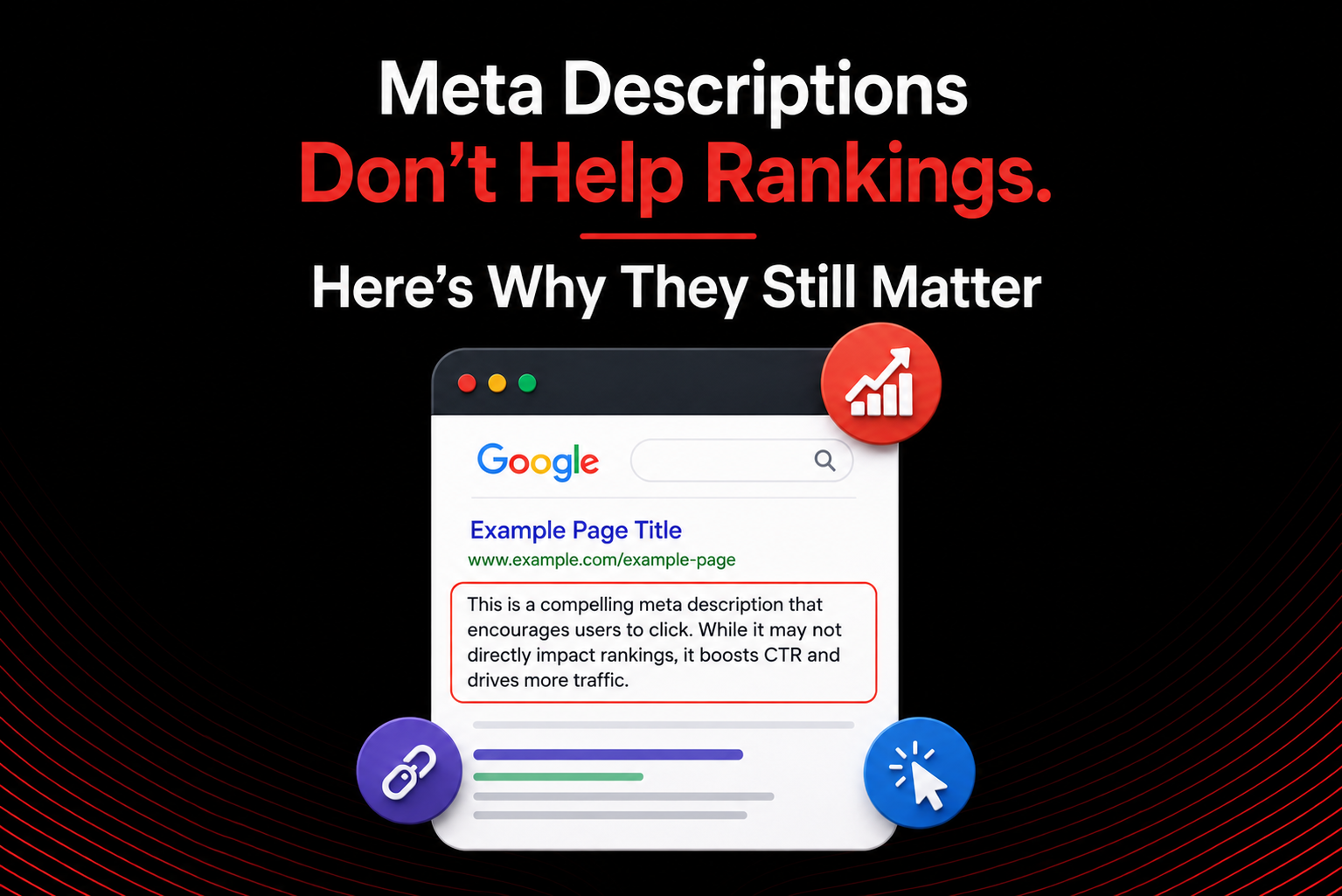
Meta Descriptions Don’t Help Rankings. Here’s Why They Still Matter
Meta descriptions are not a Google ranking factor. That has been widely understood in SEO for years.
Recent comments from Google’s John Mueller simply reinforced it. You do not need to write a meta description to rank, and there is no ranking penalty for leaving one blank. Mueller still considers them worthwhile for important pages, however, which points to the real reason we continue to write them.
A meta description may not help a page move up the rankings, but it can help a searcher understand why that page deserves their attention.
Key Takeaways
- Meta descriptions do not directly improve Google rankings.
- Google may use your meta description in search results, but it can also generate a different snippet from the page.
- We still write them for important pages because they help communicate relevance, context and value.
- Good descriptions should be specific to the page, concise, accurate and written for the person searching.
- If you manage a large website, prioritize your homepage, service pages, product pages, popular content and other commercially important URLs.
Google has reinforced what SEOs already know
In June 2026, Search Engine Journal reported on a response from Google’s John Mueller to a question about whether meta descriptions were now pointless.
His answer did not change the rules. It reinforced the long-standing position.
Writing a meta description is not required, there is no ranking penalty for skipping one, and Google can generate its own search snippet. Mueller did add that writing descriptions is still worthwhile for individual pages you care about.
You can read the original Search Engine Journal article on Google’s meta description guidance.
Google’s own Search Central documentation says that snippets are primarily created from page content. It may instead use the page’s meta description when that provides searchers with a more accurate description.
That distinction matters.
We do not write meta descriptions because we expect Google to reward the page with a higher position. We write them because search visibility has little value if the listing does not give the right person a reason to visit.
Think of the meta description as search-result copy
A ranking gets your page into consideration. The search result still has to communicate what someone will find after clicking.
The title tag does much of that work, but space is limited. The meta description gives us room to clarify the offer, explain the benefit or provide useful context that does not fit naturally into the title.
For example, a service page could use its description to mention who the service is for and the problem it solves. An ecommerce description might highlight product information that is scattered across different parts of the page.
Google specifically notes that descriptions can bring useful information together for searchers, including details such as prices, manufacturers, dates and authors.
This is why meta descriptions remain part of the on-page work within our SEO services and search optimization strategies.
How we write better meta descriptions
There is no secret formula. These are the practices we use.
Match the page to the search intent
Start with the reason someone would search for the page.
A person searching for an emergency service needs different information from someone researching a complex purchase. The description should reflect what that searcher is likely trying to accomplish.
Add to the title instead of repeating it
We treat the title and description as a pair.
If the title already says what the page is about, the description should use the available space to explain why it is useful. Add a benefit, differentiator, useful detail or next step.
Keep the important information upfront
Google does not publish a fixed character limit for meta descriptions. It truncates snippets when necessary based on factors such as the available device width.
As a practical working range, we generally aim for around 150 to 160 characters when possible. The exact character count matters less than getting the main message across early and clearly.
Use the primary keyword naturally
If the main search phrase fits naturally into the description, we include it.
We do not force multiple variations of the same term into one sentence. Google warns that long strings of keywords do not give users a clear understanding of the page and are less likely to be useful as snippets.
Write unique descriptions for important pages
Copying the same generic description across dozens of URLs wastes an opportunity to explain why each page exists.
Google recommends creating descriptions that accurately reflect the specific page and prioritizing critical URLs when writing one for every page is not practical.
We focus first on:
- The homepage
- Core service pages
- Product and category pages
- Location pages
- High-traffic articles
- Important landing pages
Describe what is actually on the page
A meta description should set an accurate expectation.
There is little value in writing clever copy that wins a click if the page does not deliver what was promised. The description should make it easier for the right visitor to choose your result.
Expect Google to rewrite it
Even a well-written meta description may not appear for every query.
Google can pull text directly from the page when it believes another passage better answers what someone searched for.
We therefore treat the description as our preferred version of the search snippet, not something Google is required to display.
The ranking-factor question misses the bigger point
Meta descriptions are a good example of why SEO should not be reduced to a checklist of ranking factors.
Their direct ranking value is effectively zero.
Their potential marketing value is not.
For pages that matter to your business, spending a few minutes writing a clear description gives Google another useful option when building the search result and gives you an opportunity to communicate what makes the page worth visiting.
If your website is ranking but organic search is not producing the traffic or leads you expect, talk to the SEO experts here at KallistoTech.
Frequently asked questions
Do meta descriptions help SEO rankings?
No. Meta descriptions are not a direct Google ranking factor. Writing one will not cause a page to rank higher simply because it has been added.
Are meta descriptions still important?
Yes, they are worthwhile for important pages. They can help communicate the subject and value of a page when Google chooses to use them in the search result.
Does Google always use the meta description I write?
No. Google primarily creates snippets from page content and may display your supplied meta description when it considers it a better description for the searcher.
How long should a meta description be?
Google has no fixed character limit. Snippets are truncated when necessary. We generally aim for roughly 150 to 160 characters while keeping the most useful information near the beginning.
Should every page have a unique meta description?
Ideally, important pages should. For very large websites, Google recommends prioritizing critical URLs such as the homepage and popular pages rather than treating manually written descriptions for every URL as a requirement.
Should a meta description contain the target keyword?
We generally include the primary phrase when it makes sense naturally. The description should read like useful search-result copy, not a list of keywords.


