


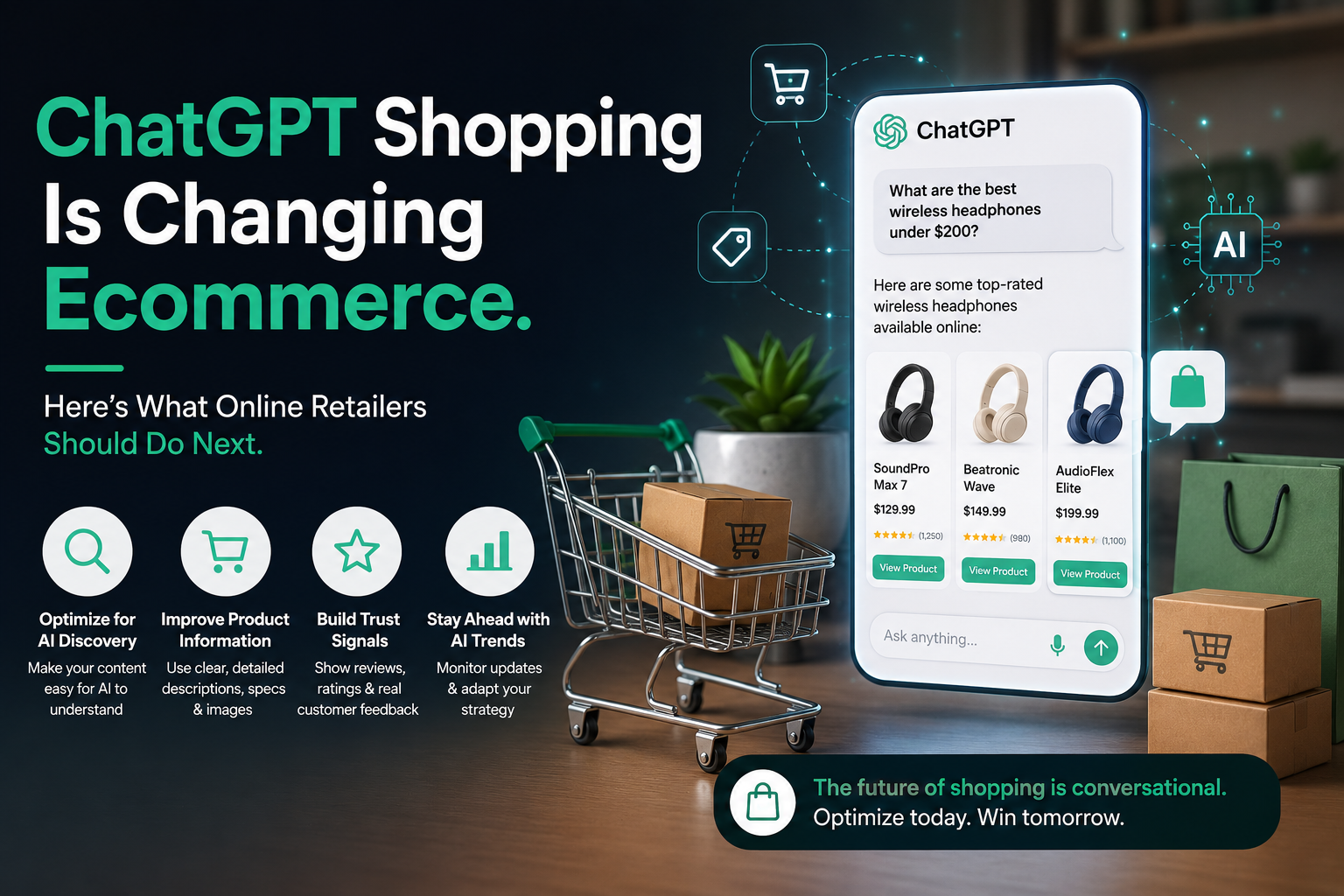
ChatGPT Shopping Is Changing Ecommerce. Here’s What Online Retailers Should Do Next.
Online shopping has traditionally followed the same path. A customer searches for a product, compares options, reads reviews, visits multiple websites, and eventually decides what to buy.
AI is changing that process.
With ChatGPT Shopping, people can simply describe what they’re looking for in plain English and receive personalized product recommendations complete with images, prices, reviews, and purchase links.
Instead of typing “carry-on luggage” into a search engine, someone might ask:
“I’m looking for a lightweight carry-on suitcase under $200 that’s durable enough for international travel.”
Within seconds, ChatGPT can recommend products that match those requirements, explain why they fit, and refine the suggestions based on follow-up questions.
For online retailers, this could be one of the biggest changes to ecommerce since Google Shopping.
Shopping is becoming a conversation
Traditional ecommerce depends on customers knowing what to search for.
AI shopping works differently.
Rather than relying on keywords, shoppers describe their needs, budget, preferences, and intended use. AI interprets those details and recommends products that best match the conversation.
That makes the buying process much faster. Instead of opening dozens of tabs and comparing endless product pages, shoppers can narrow their choices through a simple back-and-forth conversation.
The result is a more personalized shopping experience that feels less like searching and more like getting advice from a knowledgeable salesperson.
Product discovery is becoming more important than clicks
For many ecommerce businesses, the biggest shift isn’t where customers make a purchase. It’s where they discover products.
For years, Google Search, paid advertising, marketplaces, and social media have been the primary ways shoppers found new products.
Now, AI assistants are becoming another discovery channel.
If ChatGPT recommends your product during the research stage, you’ve already earned a spot on the customer’s shortlist before they ever visit your website. If your product isn’t recommended, there’s a good chance you’ll never be considered.
That’s why visibility in AI platforms is becoming just as important as visibility in traditional search.
How does ChatGPT choose which products to recommend?
Unlike paid ads, ChatGPT’s product recommendations aren’t purchased.
Instead, AI relies on the information it can understand and trust.
Retailers are more likely to be recommended when they provide:
- Clear, descriptive product titles
- Detailed product descriptions
- Complete product specifications
- Accurate pricing and inventory
- High-quality product images
- Strong customer reviews
- Structured data (Schema.org markup)
- Product pages that AI can easily access and interpret
Simply put, the better your product data, the easier it is for AI to understand your products and recommend them with confidence.
AI optimization goes beyond traditional SEO
Many online retailers already invest in SEO, but AI shopping introduces another layer of optimization.
Instead of focusing only on getting product pages to rank in Google, businesses also need to make sure AI systems can accurately understand every product they sell.
That includes:
- Maintaining clean and accurate product feeds
- Keeping pricing and inventory up to date
- Writing clear, customer-focused product descriptions
- Implementing structured data across product pages
- Building authentic reviews and other trust signals
These improvements don’t just help with ChatGPT. They also strengthen visibility across Google Shopping, traditional search, and other AI-powered shopping platforms.
Trust is becoming a competitive advantage
AI doesn’t just look for products that match a search. It also looks for products it can recommend with confidence.
When several retailers sell similar items, AI is more likely to recommend businesses with better reviews, consistent product information, reliable inventory, and stronger trust signals.
That means businesses with incomplete catalogs, outdated pricing, inconsistent product details, or weak customer reviews may become less visible, even if they offer excellent products.
In the age of AI shopping, trust is becoming another ranking factor.
What ecommerce businesses should do now
Most retailers don’t need to redesign their websites.
They do need to prepare them for AI.
Over the next few years, successful ecommerce brands will optimize for both human shoppers and AI assistants. That means giving product data, structured markup, merchant feeds, and content quality the same attention as traditional SEO.
Businesses that make these improvements today will be in a much stronger position as AI continues to influence how customers discover products online.
The bottom line
AI isn’t replacing ecommerce websites.
It’s changing how shoppers find them.
The retailers that succeed won’t necessarily be the ones with the biggest advertising budgets. They’ll be the ones that make it easiest for AI to understand, trust, and recommend their products.
As online shopping becomes more conversational, success will depend on more than ranking first in Google. It will depend on becoming the product AI recommends first.


