


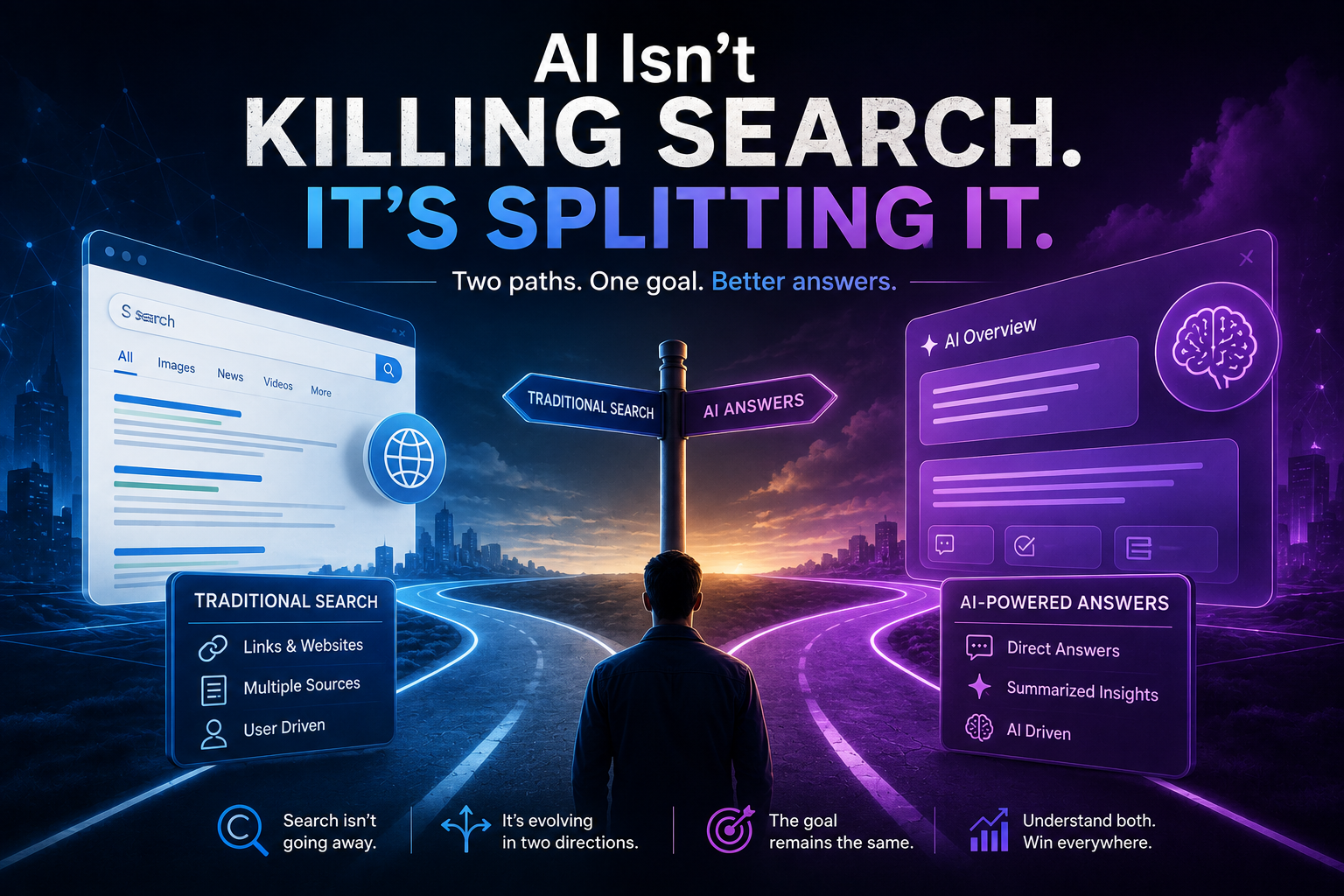
AI Isn’t Killing Search. It’s Splitting It.
For the past year, one question has dominated conversations about AI and SEO:
“Is AI replacing Google Search?”
A major new study suggests that’s the wrong question.
Researchers analyzed more than 1 million high-volume keywords across 379 brands, representing 35.4 billion monthly searches spanning eight major industries. It’s one of the largest real-world studies to date on how AI is reshaping search behavior.
The biggest takeaway?
Search isn’t disappearing. It’s evolving.
Instead of replacing Google, AI is changing where people begin their journey. Discovery is increasingly happening inside AI platforms, while Google remains the place where people validate their choices, compare options, and make purchasing decisions.
The data tells a different story
The study found that 29% of high-volume search demand is in measurable decline, confirming that AI is changing how people search online,
At first glance, that sounds like bad news.
But the decline isn’t happening evenly across every type of search.
Instead, AI is reducing searches where users simply need an answer while increasing opportunities for searches that involve evaluating brands, comparing products, or making purchasing decisions.
In other words, search isn’t disappearing. It’s shifting.
Not every industry is seeing the same impact
The industries experiencing the biggest declines are those built around informational content.
Think about searches like:
- “What causes high cholesterol?”
- “What is a deductible?”
- “How does compound interest work?”
These are questions AI can answer immediately, often without requiring someone to click through to another website.
As a result, industries such as HealthTech, FinTech, and Wellness are seeing significant declines in non-branded informational searches.
Meanwhile, industries where customers still need to research products before buying are seeing a very different trend.
SaaS, Lifestyle, Insurance, and Travel continue to perform well because AI often introduces customers to new brands, but those customers still turn to Google to compare features, read reviews, and make a final decision.
AI is changing where the customer journey begins
This may be the most important finding from the study.
AI is becoming the starting point for research.
Google is becoming the place where people validate their choices.
Imagine someone asking ChatGPT for the best project management software. The AI recommends several platforms, explains the differences, and narrows the options.
What happens next?
Most people don’t immediately buy.
They open Google, search for the recommended brands, compare pricing, read customer reviews, watch product demos, and decide which solution is right for them.
The research found that 59% of consumers are likely to visit a company’s website after it’s mentioned by an AI assistant, while only 13% begin purchase research with an AI chatbot. Most buyers still use multiple sources before making a decision.
AI is becoming the research assistant.
Google is still the checkout counter.
Businesses that show up in both places are far more likely to win customers.
What this means for your business
The right strategy depends on your business model.
If your company primarily answers questions, such as healthcare providers, financial firms, consultants, or educational organizations, your priority should be becoming a trusted source that AI systems cite when generating answers.
If you sell products, software, or professional services that customers compare before making a purchase, maintaining a strong Google presence is just as important as ever. AI may introduce people to your brand, but many buyers still rely on Google to validate their decision before converting.
The biggest risk isn’t AI replacing search.
It’s being invisible in both AI and traditional search.
That’s where many businesses find themselves today.
How businesses should adapt
Rather than treating AI and SEO as separate strategies, businesses should focus on building visibility across both.
Some practical priorities include:
- Publish original, experience-based content that demonstrates genuine expertise.
- Build topical authority instead of creating isolated blog posts.
- Optimize your content to earn AI citations as well as traditional search rankings.
- Invest in your brand so people recognize and search for it after discovering it through AI.
- Monitor both AI referral traffic and traditional organic search performance.
- Continue strengthening technical SEO, structured data, and content quality.
The businesses that adapt early will have a significant advantage as AI continues to reshape search. Recent academic research also suggests AI search is changing how information is surfaced and consumed, making authority and trust more important than ever.
The bottom line
AI isn’t killing search.
It’s changing how people use it.
Discovery is increasingly happening inside AI assistants. Comparison, validation, and purchasing decisions are still happening through Google.
Businesses that understand both parts of that journey will have a clear competitive advantage.
The future of search isn’t AI or Google.
It’s AI and Google working together.
The brands that build visibility in both places will be the ones that earn trust, attract more customers, and stay ahead as search continues to evolve.


