


SEO in 2026: How AI Search Is Changing Rankings & Why KallistoTECH Leads the Way
SEO in 2026: How AI Search Is Rewriting the Rules
Something fundamental changed regarding SEO in 2026. Therefore, businesses that were sitting comfortably on page one last year are suddenly completely invisible. Websites that barely existed six months ago are now frequently showing up in Google AI Overviews, ChatGPT recommendations, and Perplexity answers. If you are wondering why your organic positions fell, the answer is remarkably simple. The core rules of digital optimization just shifted entirely, and most marketing agencies have not caught up to the technical realities of SEO in 2026 yet.
Consequently, at KallistoTECH, we have been tracking this algorithmic shift in real time across our global client base. This breakdown analyzes exactly what is happening under the hood. Furthermore, you will discover what the current landscape looks like, alongside the specific steps your business must execute right now to master SEO in 2026 to stay visible, authoritative, and deeply competitive.
1. Why the Core Pillars of SEO in 2026 Have Shifted
For over two decades, the digital optimization game remained relatively predictable. Agencies would build external backlinks, target specific keywords, optimize individual landing pages, and wait patiently for Google to reward the domain with high organic rankings. While that exact formula still matters today, relying solely on old methods is no longer sufficient when building a strategy for SEO in 2026.
The Omni-Channel Search Ecosystem
Today, user search happens everywhere simultaneously. For instance, consumers get immediate answers from automated Google AI Overviews, ask ChatGPT for localized business recommendations, utilize Perplexity for deep data research, and rely heavily on voice assistants for quick on-the-go lookups. Crucially, each of these advanced platforms possesses its own distinct method of deciding whose content to surface.
Key Statistics
Google processes approximately 14 billion search queries daily. Meanwhile, OpenAI’s ChatGPT reaches around 37.5 million—but that secondary metric is accelerating fast. Brands that appear prominently in AI-generated answers today are successfully building tomorrow’s dominant market positions through proactive execution of SEO in 2026.
Consequently, the businesses winning market share right now are not simply the ones holding the highest number of backlinks. Instead, they are the organizations whose content is structured so clearly, so authoritatively, and so specifically that large language models trust it enough to cite it explicitly. Achieving that milestone requires a fundamentally different kind of technical expertise.
2. Three Vital Disciplines of SEO in 2026 You Must Understand
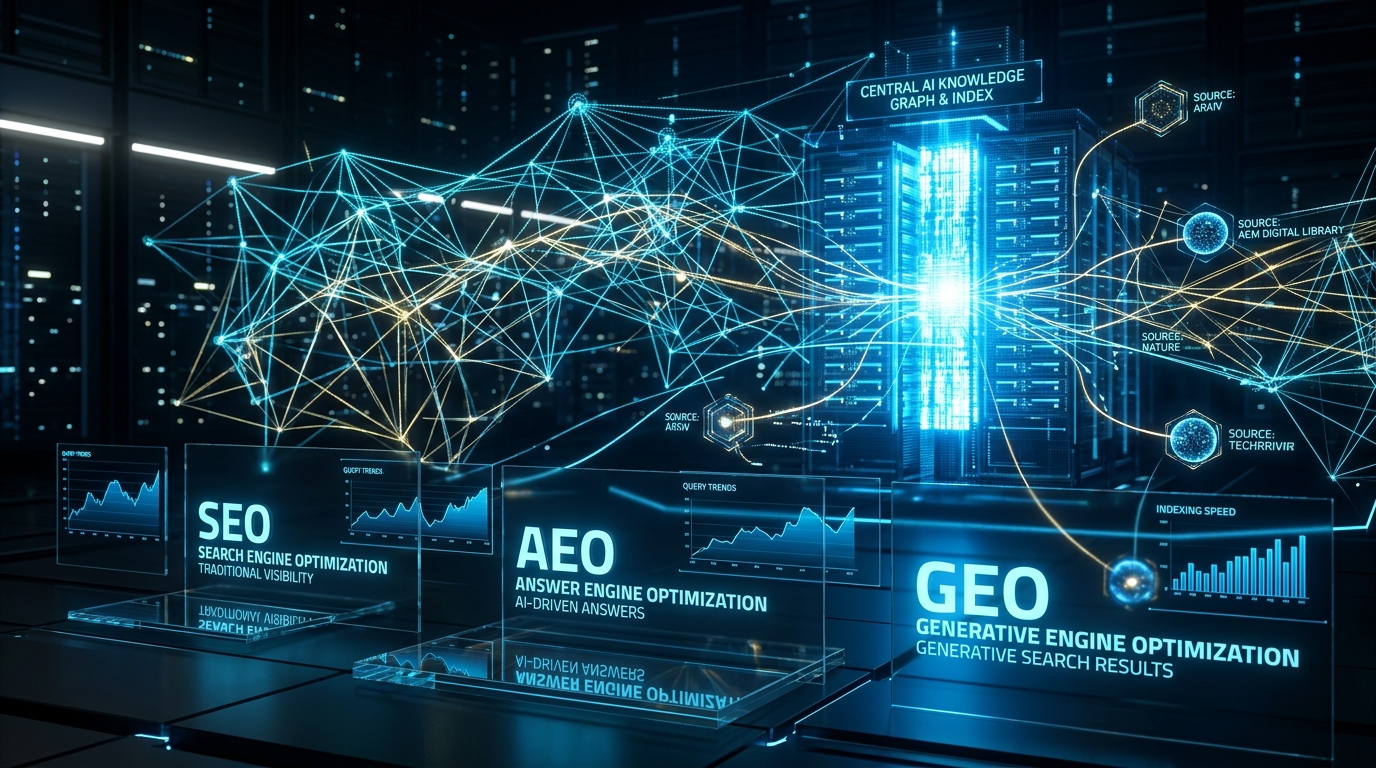
You will encounter a variety of brand-new marketing acronyms being thrown around this year. Therefore, let us define exactly what they mean and why they matter to your bottom line as we break down the ecosystem of SEO in 2026:
Search Engine Optimization (SEO) — Still the Foundation
Traditional SEO is certainly not dead. Technical site health, fast Core Web Vitals, local citations, and premium backlinks still drive foundational organic rankings on Google. Therefore, if you neglect these absolute basics, nothing else will save your site. The primary difference is that standard optimization now feeds directly into a much larger machine-learning ecosystem.
Answer Engine Optimization (AEO) — Owning the Direct Answer
AEO is the explicit practice of structuring web content so that AI-powered search engines can extract it directly as an instant snippet answer. Think of this discipline as the highly evolved version of featured snippets. When an enterprise executive asks an engine “what is the best SEO company in the USA,” AEO directly determines whether your brand gets cited as the answers surface, or if your competitor gets the nod.
To win at AEO under the framework of SEO in 2026, your pages must heavily leverage advanced FAQ schema, concise question-and-answer structural blocks, and highly granular JSON-LD structured data markup.
Generative Engine Optimization (GEO) — Being Found by LLMs
GEO goes one step deeper into machine learning. Specifically, it focuses on ensuring that large language models (LLMs) like GPT-4o, Gemini 1.5, and Claude 3.5 seamlessly associate your brand name with your specific industry vertical. This advanced discipline requires systematically building deep entity authority. You achieve this by establishing consistent data signals across your main website, third-party press mentions, and open-source linked databases.
| Optimization Factor | Traditional SEO (2022) | AI-Era SEO + AEO (2026) |
| Primary Goal | Rank #1 on standard Google SERP | Get cited in conversational AI answers |
| Content Format | Keyword-dense paragraphs | Highly structured, direct Q&A blocks |
| Optimization Target | Standard search engine crawlers | Advanced LLMs + hybrid web crawlers |
| Key Performance Signal | Backlinks & literal keyword depth | Topical authority + clear entity signals |
| Schema Markup | Deemed completely optional | Absolutely essential (JSON-LD) |
3. Why Most Businesses Are Losing Visibility with SEO in 2026
The single biggest mistake we observe brands making is continuing to apply outdated, legacy SEO tactics to a highly complex conversational search environment. Specifically, here are the most common traps causing visibility loss when adapting to SEO in 2026:
-
Publishing keyword-stuffed articles that fail to answer a specific search query directly.
-
Deploying websites with completely missing or malformed JSON-LD schema markup.
-
Ignoring digital PR, missing brand mentions, and lacking external authoritative citations.
-
Optimizing your web properties exclusively for Google while ignoring purchasing traffic originating from alternative platforms.
-
Writing thin content that covers too many superficial topics instead of building real topical depth.
The Hard Truth
Industry data indicates that fewer than 9% of citations in ChatGPT and Google Gemini responses originate from URLs that rank in Google’s traditional top 10 organic results. Therefore, ranking alone is no longer the final goal. Your brand must be citable.
4. The Actionable Playbook for Winning at SEO in 2026
Building a highly visible digital footprint requires architectural precision. Here is the exact modern strategy that leading brands deploy for sustained conversion growth:
A. Technical Site Health as the Core Base
AI crawlers penalize poorly optimized web infrastructure. Because of this, your pages require a Largest Contentful Paint (LCP) score under 2.5 seconds, clean directory architecture, and proper canonical setup. For step-by-step guidance on setting up these parameters, view comprehensive Technical Site Audit Checklist .
B. Structured Content Block Formatting
Modern search interfaces are built to summarize bulk information instantly. Content that buries the core answer beneath long introductory paragraphs gets skipped by LLM parsers entirely. Therefore, ensure every primary page addresses its core query within the first three sentences to align with the standards of SEO in 2026.
C. Advanced JSON-LD Schema Deployments
If your business data is not properly translated into structured code, your brand remains virtually invisible to the AI layer of search. Consequently, implementing custom Organization, Service, Product, and Local Business schema markup is now a mandatory requirement for successful execution of SEO in 2026.
D. Developing True Topical Authority
Instead of creating isolated individual blogs targeting single keyword phrases, you must design comprehensive content clusters. These interconnected silos firmly establish your domain as the absolute authority on a given topic, signalling deep expertise to search bots.
5. Local SEO in the AI Era: More Complex, Highly Critical
If you manage a localized business, regional optimization remains one of the highest-ROI marketing investments available. However, the exact deployment dynamics have shifted significantly.
AI discovery systems now evaluate your regional credibility by programmatically parsing multiple external data signals simultaneously. For example, they audit your Google Business Profile completion percentage, check your ongoing review velocity, cross-examine your local citation consistency (NAP metrics), and read third-party localized blog publications.
Furthermore, mobile voice search has shifted completely toward natural user intent. When a prospective customer asks their device to “find the top digital firm near me,” the underlying AI does not merely query the closest map pack. It meticulously judges which entity is the most trusted, most reviewed, and most technically accessible across open data pools.
Pro Tip From Our Growth Team
Always build hyper-specific geo-targeted landing pages equipped with custom FAQ blocks. Additionally, implement local schema matching your exact service boundaries. Gather customer reviews consistently, as LLM models heavily weigh review velocity over raw star ratings.
6. Modern Performance Metrics for Measuring SEO in 2026
If your current marketing reports only display keyword tracking tables and raw session numbers, you are analyzing incomplete data. A modern, growth-oriented analytics framework built for SEO in 2026 tracks the following key metrics:
-
AI Overview Share of Voice: How frequently your brand is referenced in synthesized summaries.
-
LLM Citation Volume: The exact rate at which ChatGPT, Claude, and Perplexity reference your URLs.
-
Entity Knowledge Graph Presence: Confirming whether your brand has generated an official Google Knowledge Panel.
-
Core Web Vitals Metric Health: Maintaining peak LCP, INP, and CLS scores across all mobile layouts.
7. Why Brands Partner with KallistoTech for 2026 Digital Growth
There is certainly no shortage of digital agencies making lofty promises. However, what separates KallistoTech from the competition is our 18+ years of real-world enterprise execution, our integrated global teams, and our massive internal investment in predictive algorithm analysis.
We do not just manage basic keywords; instead, our engineers design complete digital growth ecosystems. Our full-service packages combine advanced technical optimization, localized authority mapping, and direct API lead-funnel integrations to ensure your organic traffic converts seamlessly into recurring business revenue.
8. Frequently Asked Questions (FAQ): Mastering SEO in 2026
Q: What is the difference between SEO, AEO, and GEO?
A: SEO (Search Engine Optimization) focuses on ranking your website on Google and other search engines. AEO (Answer Engine Optimization) focuses on getting your content cited as a direct answer in AI-powered search results and voice assistants. GEO (Generative Engine Optimization) focuses on making your brand recognizable and citable by large language models like ChatGPT and Google Gemini. In 2026, a complete strategy requires all three working together.
Q: How has Google’s AI Mode changed SEO in 2026?
A: Google’s AI Mode uses a technique called query fan-out — it breaks down a search question into multiple sub-queries and synthesizes an answer from various sources. This means your content now competes not just for a keyword ranking, but for inclusion in a synthesized AI answer. Pages with clear, structured, factually accurate content that directly answers questions are favored. Click-through rates from these overviews are lower, which is why brand visibility and conversions from AI traffic are now the key metrics.
| Ready to Dominate Search in 2026?
KallistoTech is the best SEO company in USA for businesses that want to grow — not just rank. 🌐 kallistotech.com 📞 (813) 575-2525 ✉️ contact@kallistotech.com |
© 2026 KallistoTech. All rights reserved. | kallistotech.com


